IATA compliant hard crates
Airline approved pet crates
Every pet that flies as cargo in Canada travels in a rigid airline crate that fits it properly. Here are the sizes, how we work out the right one, and the rules Air Canada and WestJet check at the cargo counter.
Sizes
Airline crate sizes
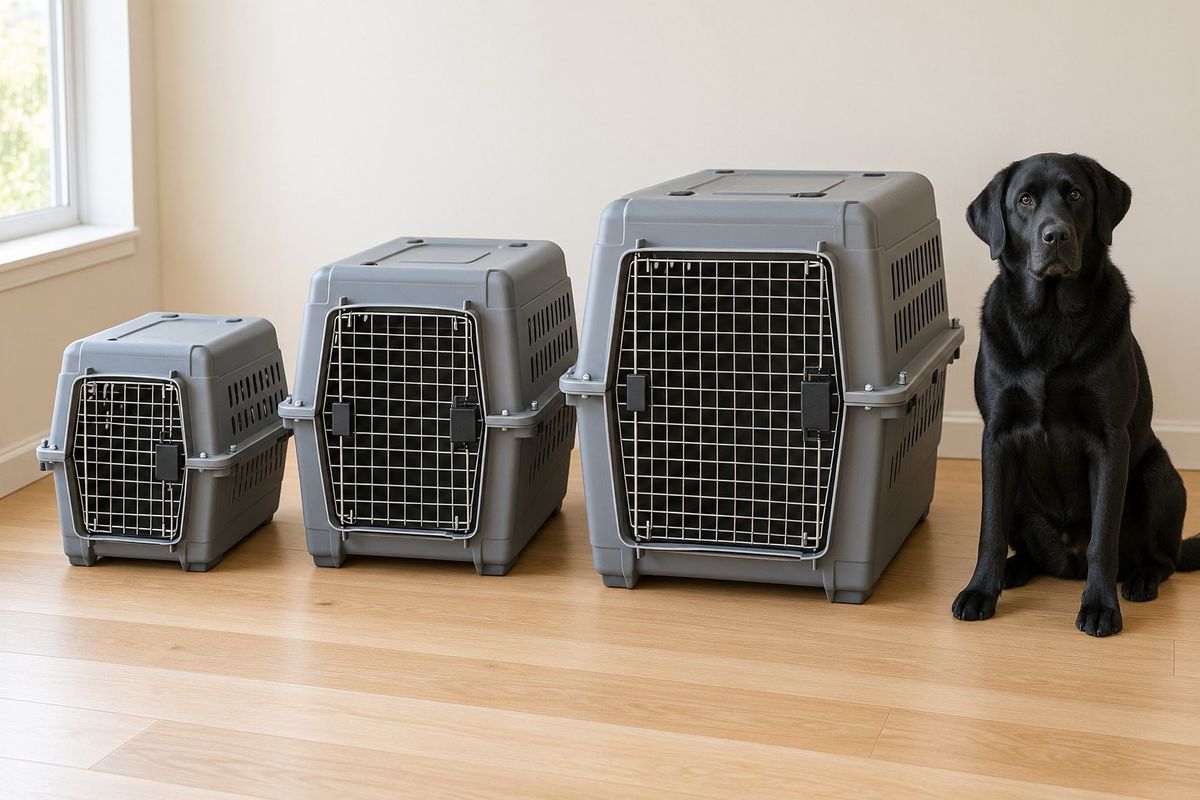
Airlines price and load a pet by the size of its crate, from Small (21 inches long) to Giant (48 inches). Shops sell crates by series numbers (100 to 700), and each brand's sizes are a little different, so go by the outside size: a crate counts as the smallest size it fits inside.
| Size | Outside, at most (L x W x H) | Room inside, about | Empty crate | Pet weight guide |
|---|---|---|---|---|
| Small | 21 x 15 x 15 in 53.3 x 38.1 x 38.1 cm | 18.75 x 12.5 x 14.5 in 47.6 x 31.8 x 36.8 cm | 4.1 kg | up to 15 lb (7 kg) |
| Junior | 27 x 20 x 19 in 68.6 x 50.8 x 48.3 cm | 23.25 x 17.75 x 17 in 59.1 x 45.1 x 43.2 cm | 6.4 kg | up to 30 lb (14 kg) |
| Medium | 32 x 22 x 23 in 81.3 x 55.9 x 58.4 cm | 29.5 x 19.25 x 22.5 in 74.9 x 48.9 x 57.2 cm | 9.1 kg | up to 50 lb (23 kg) |
| Large | 36 x 24 x 24 in 91.4 x 61.0 x 61.0 cm | 32.5 x 21 x 23 in 82.6 x 53.3 x 58.4 cm | 10.9 kg | up to 70 lb (32 kg) |
| Extra Large | 40 x 27 x 30 in 101.6 x 68.6 x 76.2 cm | 36.25 x 24.75 x 28.8 in 92.1 x 62.9 x 73.2 cm | 12.7 kg | up to 90 lb (41 kg) |
| Magnum | 45 x 27 x 33 in 114.3 x 68.6 x 83.8 cm | 41.1 x 24.4 x 31.15 in 104.4 x 62.0 x 79.1 cm | 18.1 kg | up to 110 lb (50 kg) |
| Giant | 48 x 32 x 35 in 121.9 x 81.3 x 88.9 cm | 44 x 29 x 32.5 in 111.8 x 73.7 x 82.6 cm | 23.1 kg | up to 125 lb (57 kg) |
We choose the size from your pet's measurements first. If your pet is heavier than the weight guide for that size, we go up to the size meant for that weight. A pet too big for Giant needs a custom wooden crate, which we price by hand.
By breed
Typical crate size by breed
This is the typical minimum for an adult of standard size. We take each breed's adult height at the shoulder and weight from its breed standard and put them through the same rules as our calculator: the weight against each size's pet weight guide, and the shoulder height, plus room for bedding, against the inside height. A dog's head stands higher than its shoulders, and the standard gives no body length, so your own dog may need a bigger crate. Measure your pet in the crate size calculator: its result always wins over this chart.
| Breed | Adult size (standard) | Typical crate | Airline notes |
|---|---|---|---|
| Australian Shepherd | 18 to 23 in (46 to 58 cm) at the shoulder40 to 65 lb (18 to 29 kg) | Medium to Extra Large | None |
| BeagleThe 13 to 15 inch variety. Beagles 13 inches and under weigh under 20 lb. | 13 to 15 in (33 to 38 cm) at the shoulder20 to 30 lb (9 to 14 kg) | Junior or Medium | None |
| Bernese Mountain Dog | 23 to 27.5 in (58 to 70 cm) at the shoulder70 to 115 lb (32 to 52 kg) | Extra Large to Giant | None |
| Border Collie | 18 to 22 in (46 to 56 cm) at the shoulder30 to 55 lb (14 to 25 kg) | Medium to Extra Large | None |
| Boston Terrier | 10 to 12 in (25 to 30 cm) at the shoulder12 to 25 lb (5 to 11 kg) | Small or Junior | Snub-nosed: 10% more room, extra airline rules |
| BoxerMales 65 to 80 lb; the AKC says females weigh about 15 lb less. | 21.5 to 25 in (55 to 64 cm) at the shoulder50 to 80 lb (23 to 36 kg) | Extra Large or Magnum | Snub-nosed: 10% more room, extra airline rules |
| Bulldog (English Bulldog) | 14 to 15 in (36 to 38 cm) at the shoulder40 to 50 lb (18 to 23 kg) | Medium | Snub-nosed: 10% more room, extra airline rules |
| Bullmastiff | 24 to 27 in (61 to 69 cm) at the shoulder100 to 130 lb (45 to 59 kg) | Magnum to a custom crate | Snub-nosed: 10% more room, extra airline rulesStrong breed: reinforced crate (IATA CR 82) |
| Cane CorsoThe AKC gives no weight ("proportionate to height"); the weight is the FCI standard's. | 23.5 to 27.5 in (60 to 70 cm) at the shoulder88 to 110 lb (40 to 50 kg) | Extra Large to a custom crate | Snub-nosed: 10% more room, extra airline rulesStrong breed: reinforced crate (IATA CR 82) |
| Cavalier King Charles Spaniel | 12 to 13 in (30 to 33 cm) at the shoulder13 to 18 lb (6 to 8 kg) | Junior | Snub-nosed: 10% more room, extra airline rules |
| ChihuahuaOnly the apple-headed type is on the airlines' snub-nosed lists. | 5 to 8 in (13 to 20 cm) at the shoulderup to 6 lb (up to 3 kg) | Small | Snub-nosed: 10% more room, extra airline rules |
| Cocker Spaniel | 13.5 to 15.5 in (34 to 39 cm) at the shoulder20 to 30 lb (9 to 14 kg) | Junior or Medium | None |
| Dachshund (standard)Long for its height: measure the length. | 8 to 9 in (20 to 23 cm) at the shoulder16 to 32 lb (7 to 15 kg) | Junior or Medium | None |
| Doberman Pinscher | 24 to 28 in (61 to 71 cm) at the shoulder60 to 100 lb (27 to 45 kg) | Extra Large or Magnum | Strong breed: reinforced crate (IATA CR 82) |
| French Bulldog | 11 to 13 in (28 to 33 cm) at the shoulderup to 28 lb (up to 13 kg) | Junior | Snub-nosed: 10% more room, extra airline rules |
| German Shepherd Dog | 22 to 26 in (56 to 66 cm) at the shoulder50 to 90 lb (23 to 41 kg) | Extra Large | None |
| German Shorthaired Pointer | 21 to 25 in (53 to 64 cm) at the shoulder45 to 70 lb (20 to 32 kg) | Extra Large | None |
| Golden Retriever | 21.5 to 24 in (55 to 61 cm) at the shoulder55 to 75 lb (25 to 34 kg) | Extra Large | None |
| Great Dane | 28 to 32 in (71 to 81 cm) at the shoulder110 to 175 lb (50 to 79 kg) | Magnum to a custom crate | None |
| Havanese | 8.5 to 11.5 in (22 to 29 cm) at the shoulder7 to 13 lb (3 to 6 kg) | Small | None |
| Labrador Retriever | 21.5 to 24.5 in (55 to 62 cm) at the shoulder55 to 80 lb (25 to 36 kg) | Extra Large | None |
| Maltese | 7 to 9 in (18 to 23 cm) at the shoulderup to 7 lb (up to 3 kg) | Small | None |
| MastiffThe standard sets only a lowest height (30 inches and up for males). | 27.5 in and up (70 cm and up) at the shoulder120 to 230 lb (54 to 104 kg) | Giant or a custom crate | Strong breed: reinforced crate (IATA CR 82) |
| Miniature Schnauzer | 12 to 14 in (30 to 36 cm) at the shoulder11 to 20 lb (5 to 9 kg) | Small or Junior | None |
| Pembroke Welsh Corgi | 10 to 12 in (25 to 30 cm) at the shoulderup to 30 lb (up to 14 kg) | Junior | None |
| Pomeranian | 6 to 7 in (15 to 18 cm) at the shoulder3 to 7 lb (1 to 3 kg) | Small | None |
| Poodle (Miniature) | 10 to 15 in (25 to 38 cm) at the shoulder10 to 15 lb (5 to 7 kg) | Small to Medium | None |
| Poodle (Standard)The standard sets only a lowest height (over 15 inches): measure a tall one. | over 15 in (over 38 cm) at the shoulder40 to 70 lb (18 to 32 kg) | Medium or Large | None |
| Pug | 10 to 13 in (25 to 33 cm) at the shoulder14 to 18 lb (6 to 8 kg) | Small or Junior | Snub-nosed: 10% more room, extra airline rules |
| Rhodesian Ridgeback | 24 to 27 in (61 to 69 cm) at the shoulder70 to 85 lb (32 to 39 kg) | Extra Large or Magnum | Strong breed: reinforced crate (IATA CR 82) |
| Rottweiler | 22 to 27 in (56 to 69 cm) at the shoulder80 to 135 lb (36 to 61 kg) | Extra Large to a custom crate | Strong breed: reinforced crate (IATA CR 82) |
| Shetland Sheepdog | 13 to 16 in (33 to 41 cm) at the shoulder15 to 25 lb (7 to 11 kg) | Junior or Medium | None |
| Shih Tzu | 9 to 10.5 in (23 to 27 cm) at the shoulder9 to 16 lb (4 to 7 kg) | Small or Junior | Snub-nosed: 10% more room, extra airline rules |
| Siberian Husky | 20 to 23.5 in (51 to 60 cm) at the shoulder35 to 60 lb (16 to 27 kg) | Medium to Extra Large | None |
| Yorkshire Terrier | 7 to 8 in (18 to 20 cm) at the shoulderup to 7 lb (up to 3 kg) | Small | None |
Snub-nosed and strong breeds are flagged from the airlines' own lists; we price those moves by hand. Mixed breeds and doodles have no breed standard, so measure them.
Cats follow the same rules. A cat up to 15 lb is within the Small size's weight guide; a heavier or longer cat goes up to Junior. British Shorthair, Burmese, Exotic Shorthair, Himalayan, Persian, Selkirk Rex and Scottish Fold cats are on WestJet's snub-nosed list. The Sphynx is hairless: WestJet does not carry hairless breeds as cargo from December 1 to March 31.
Where the breed sizes come from
Height at the shoulder and adult weight from each breed's page at the American Kennel Club (AKC), which gives the breed standard's numbers, and one weight from the FCI standard, all read on November 1, 2026. Where the standard gives males and females separately, the range runs from the smallest female to the largest male.
- AKC: Australian Shepherd
- AKC: Beagle
- AKC: Bernese Mountain Dog
- AKC: Border Collie
- AKC: Boston Terrier
- AKC: Boxer
- AKC: Bulldog
- AKC: Bullmastiff
- AKC: Cane Corso
- FCI standard 343: Cane Corso Italiano (13.10.2023)
- AKC: Cavalier King Charles Spaniel
- AKC: Chihuahua
- AKC: Cocker Spaniel
- AKC: Dachshund
- AKC: Doberman Pinscher
- AKC: French Bulldog
- AKC: German Shepherd Dog
- AKC: German Shorthaired Pointer
- AKC: Golden Retriever
- AKC: Great Dane
- AKC: Havanese
- AKC: Labrador Retriever
- AKC: Maltese
- AKC: Mastiff
- AKC: Miniature Schnauzer
- AKC: Pembroke Welsh Corgi
- AKC: Pomeranian
- AKC: Poodle (Miniature)
- AKC: Poodle (Standard)
- AKC: Pug
- AKC: Rhodesian Ridgeback
- AKC: Rottweiler
- AKC: Shetland Sheepdog
- AKC: Shih Tzu
- AKC: Siberian Husky
- AKC: Yorkshire Terrier
Sizing
How we pick the minimum crate
The airlines use the IATA formula. Your pet must be able to stand up without the head or ears touching the roof, turn around, and lie down in a natural position. You take four measurements with your pet standing:
- Length inside the crate: at least A (nose to base of tail) plus half of B (floor to elbow).
- Width: at least C (across the shoulders or widest point) times two.
- Height: at least D (floor to top of head or ear tips, whichever is higher), plus 4 cm for the bedding.
We add 2 cm to each size, because measuring a wriggly pet at home is never exact. For snub-nosed breeds, IATA asks for a crate 10% larger, so we add that too. Then we pick the smallest size whose inside length, width and height are all big enough. If one of them is short, for example the length, it is the next size up. Last, we check your pet's weight against the weight guide and go up a size if needed.
When we suggest a crate, it looks like this:
Suggested minimum crate size: Medium (32 x 22 x 23 inches)
The crate size is an estimate based on the details you enter. Your pet may need a bigger crate once we see them in person, and the airline makes the final call at check-in. We will confirm the crate before we order it.
It is always a minimum and always an estimate. If your pet is between sizes, go bigger.
Ready to fly
We sell airline crates in every size
What comes with it
- A rigid airline crate in the size your pet needs
- Fitting to your pet, with metal hardware checked
- Absorbent bedding
- Food and water dishes fixed to the door, fillable from outside
- "LIVE ANIMAL" and "THIS WAY UP" labels
- Cable ties for the door
- Delivery to you before the move, so your pet can get used to it
How it works
We supply every size, from Small to Giant, and the crate is added to your quote if you need one. We confirm the size with you before we order. We sell crates; we do not rent them for flights.
Already have a crate? You can use it if it meets the rules below and fits your pet. Tell us its outside size before we book, and we will check it.
Leave the crate open at home for a week or two before the flight, with a familiar blanket inside. Pets that see the crate as their own space travel more calmly.
Airline kennel rules (Air Canada and WestJet)
Both airlines check the crate at the cargo counter. If it does not meet these rules, your pet does not fly.
- Meets the IATA Live Animals Regulations: rigid plastic in two parts (top and bottom), solid roof, no door on top.
- Metal grill door, and metal nuts and bolts holding the two halves together. Plastic fasteners or clips alone are not accepted.
- Ventilation on all four sides. Openings no bigger than 25 x 25 mm for dogs, 19 x 19 mm for cats.
- No wheels (take them off). No wire, collapsible or soft crates.
- Food and water dishes fixed to the door and fillable from outside.
- Absorbent bedding, such as a towel or blanket. No wood chips or shavings.
- "LIVE ANIMAL" and "THIS WAY UP" labels. Air Canada wants the documents in a pouch on top.
Where IATA comes in
A crate that meets these rules is often called an IATA approved crate, though IATA publishes the container requirements rather than approving crates. IATA's live animals page, read on October 14, 2026, describes its Live Animals Regulations as the worldwide standard for carrying live animals by air. Air Canada Cargo's page asks for a kennel that conforms to them, and WestJet Cargo's page says containers must meet them. So the label on the box is not what counts: the airline checks the crate itself, and whether it fits your pet, at the cargo counter.
Size limits on the plane
WestJet's narrow-body aircraft take crates up to 30 inches high, which means up to Extra Large (30 inches high). On WestJet, bigger crates fly on the 787 only. Air Canada does not publish a size limit per aircraft, so we check the aircraft for the biggest crates before we book.
Strong breeds
Breeds on the airlines' strong breed lists, such as Rottweilers, Mastiffs and Cane Corsos, need a reinforced crate built to the IATA CR 82 standard, not a standard plastic crate. We price these moves by hand.
Last checked against the airlines' own pages on October 1, 2026.
Airlines change their rules. Always check the official page before you book.
Cabin carriers and cargo crates are not the same
Many "flight approved pet carriers" are soft bags made for the cabin. They fit under the seat in front of you, and only small cats and dogs can use them. Each airline sets its own cabin carrier size, so check the airline's page before you buy one.
Cargo is different. A pet flying on its own, or in the hold, must travel in a rigid airline crate that meets the rules above. Porter and Flair take small pets in the cabin only, and do not carry pets as cargo. For a move with Air Canada Cargo or WestJet Cargo, you need a hard crate.
We do not sell soft cabin carriers. If you are flying with a small pet in the cabin, see the Air Canada pet policy or the WestJet pet policy for carrier sizes.
Airline crates: questions
What is an airline approved dog crate?
What size crate does my dog need to fly?
Is an IATA compliant crate the same as an airline approved crate?
Can I use a soft carrier on the plane?
Do you rent crates?
Can two pets share a crate?
Need the crate and the flight sorted?
We size it from your pet's measurements, supply it ready to fly, and book the flight too. The crate is added to your quote if you need one.