Dogs, by air and by road
Dog transport and dog relocation
We move dogs door to door, by road, by air or both, within Canada, between Canada and the US, and to and from other countries. A move can also start or end at the airport. Toronto is our home base. We plan the safest way for each dog, with a driver at each end.
Three ways your dog can move
Across Canada, by road or air
Between Toronto and cities across Canada: by air for a move across the country, or by road, door to door, for example to Ottawa or Montreal.
Between Canada and the US
Door to door in both directions, with customs clearance arranged at the border.
Overseas, both ways
From Toronto to the UK, Europe, Asia, Australia and other countries, and to Toronto from abroad.
How a dog move from Toronto works
For a move across the country, your dog flies as airline cargo. That means an airline approved crate, a booking in your dog's name, and check-in at the airline's cargo office rather than the passenger terminal. You do not need to be on the same flight, or fly at all. Within Canada we book a Canadian airline that flies your route and takes pets as cargo. Moving overseas? We book an airline that flies your route and accepts dogs as cargo.
Our part is everything around the flight. We confirm the crate size from your dog's measurements (the quote form asks for them) before you book and sell the crate, drive your dog to your own vet for the health certificate when the airline needs one, book the cargo space, collect your dog at home and check them in at Pearson. At the other end, a driver collects your dog at the airline's cargo office and brings them to the new home. You get a message at each step.
Step 1: Pickup at home
A driver collects your dog at your door, in the crate, timed for the airline's drop-off window about 3 hours before the flight.
Step 2: Check-in at Pearson
We hand over the paperwork at the cargo office, the airline checks and weighs the crate, and we send you the air waybill number.
Step 3: The flight
Your dog travels in the hold on its own air waybill. We follow the flight and tell you when it lands.
Step 4: Delivered home
A driver collects your dog at the cargo office in the destination city once they are released, and drives them to the new home.
Before the flight
What a dog needs to fly
The crate
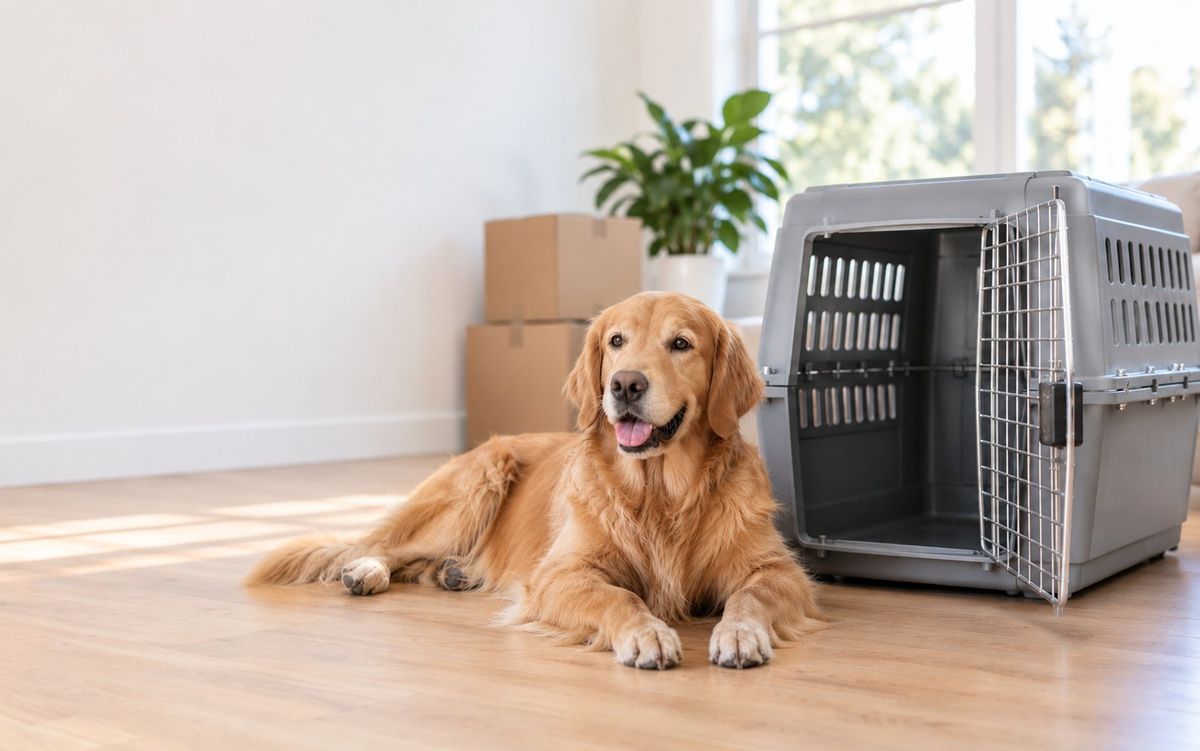
In the air, every dog travels in a rigid airline crate: solid roof, metal door, metal nuts and bolts, air holes on all sides, absorbent bedding, and a water dish you can fill from outside. Crate sizes run from Small to Giant: Small, Junior, Medium, Large, Extra Large, Magnum and Giant.
We size the crate from four measurements of your dog standing: A, nose to the base of the tail; B, floor to elbow; C, width across the shoulders; D, floor to the top of the head or ear tips. Your dog must be able to stand without the ears touching the roof, turn around and lie down. Then we check the weight and go up a size if needed. The size is always an estimate until we see your dog: a bigger crate may be needed once they are measured, and the airline makes the final call at check-in. Use the crate size calculator. The crates we sell are on airline pet crates.
The health certificate
On Air Canada Cargo, a health certificate is required for every pet shipped as cargo, from a licensed vet, dated no more than 30 days before travel. On WestJet Cargo, a health certificate is needed only for snub-nosed breeds, pets 8 to 12 weeks old, and pets that are sedated or have had recent surgery. It is valid for 10 days. Any licensed vet can sign it. We tell you which applies when we book, and we can drive your dog to your own vet and back. See vet health certificate for flying.
Age
Dogs must be at least 8 weeks old on WestJet Cargo and 10 weeks old on Air Canada Cargo. On WestJet, puppies 8 to 12 weeks old need a vet health certificate.
Weather and holidays
WestJet does not carry pets as cargo on its 737 and Q400 aircraft from December 18 to January 4. Only 787 flights can carry pets as cargo in that window. Air Canada's cargo page says it does not carry cats or dogs as cargo within Canada from December 15 to January 12. From November 1 to March 31, Air Canada does not carry animals as cargo on some narrow-body aircraft.
Neither airline has a dated summer embargo within Canada. Air Canada rebooks pets when it is 29.5°C or hotter at the origin, the destination or along the way, and WestJet may decline snub-nosed breeds in hot weather. Details in our guide to winter and holiday embargoes.
Food, water and sedation
Ask your vet about food on travel day. WestJet Cargo recommends no food for adult dogs within 6 hours of departure (4 hours for puppies). Water and food dishes are fixed to the crate door. Do not give a sedative unless your vet says so: Air Canada's pet page says tranquilizers are not recommended, and on WestJet a sedated dog needs a vet health certificate.
Large breeds
Big dogs and giant crates
Big dogs fly as cargo too. A dog the size of a Labrador is often an Extra Large crate. Great Danes, Newfoundlands and other giant breeds need the Magnum and Giant sizes, and sometimes a crate built to order.
The biggest crates do not fit every aircraft, so for dogs in the Magnum and Giant sizes we check the aircraft on your route and dates before we confirm anything. Dogs that need a Giant crate, or something bigger, need extra checks before we price the move. We prepare your quote and email it to you once it is ready.
Crate size drives the cost of a big dog's flight. Airlines charge by chargeable weight: the greater of the real weight of your dog and crate, and the volume weight worked out from the crate's outside size. A bigger crate takes more space, so it costs more to fly, even for a lean dog. Measuring carefully matters: a crate one size too big costs more for nothing, and a crate too small is refused at check-in.
If your dog is too big for any airline crate, or your vet advises against flying, we tell you early and plan around it.
Breed rules
Snub-nosed and strong breeds
Snub-nosed breeds
Short-nosed breeds such as Pug, Bulldog, French Bulldog, Boston Terrier, Boxer and Shih Tzu have extra rules, and mixes of these breeds count too. Air Canada Cargo takes them only through an IPATA approved pet shipping company. WestJet Cargo takes them with a vet health certificate, at a higher airline rate, and may decline them in hot weather. IATA asks for a crate about 10% bigger for these breeds.
Worried about flying? Tell us in the form and we plan around it. The full breed lists for each airline are on our guide to snub-nosed breeds and flying.
Strong breeds
Breeds such as Rottweiler, Mastiff, Cane Corso and Dogo Argentino must fly in a reinforced crate built to IATA Container Requirement 82, not a standard plastic crate. On WestJet, dogs of these breeds over 6 months old can only be booked by an IPATA registered agent. Pit bull type dogs (Pit Bull, American Pit Bull Terrier, American Staffordshire Terrier and Staffordshire Bull Terrier) are restricted in Ontario under the Dog Owners' Liability Act and cannot travel through Pearson.
We check every snub-nosed and strong breed move against the airline rules and email the quote once it is ready, or explain what is possible.
Breeders and new owners
Shipping a puppy from a breeder
Breeders and new owners can use us to send a puppy to its new home in another city. The breeder or the buyer can book. The move works like this.
- Age. A puppy must be at least 8 to 10 weeks old, depending on the airline: 8 weeks on WestJet Cargo and 10 weeks on Air Canada Cargo. On WestJet, puppies 8 to 12 weeks old need a vet health certificate. Tell us the puppy's date of birth and we plan the date around it.
- Forms. The person who books is the shipper on the airline's paperwork and signs the shipper's certificate for live animals. We prepare the forms and labels, and bring them to the cargo office. The breeder provides the vet health certificate when the airline needs one, or we drive the puppy to the vet for it.
- Handover at the breeder's. A driver collects the puppy at the breeder's address in the crate we supply, with the paperwork, and checks it in at Pearson cargo. The breeder gets a message with the air waybill number.
- Handover to the new owner. A driver collects the puppy at the airline's cargo office in the destination city once it is released, and delivers it to the new owner's door. The new owner gets a message when the flight lands and when the puppy is on its way.
- Strong breed puppies. On WestJet, puppies of strong breeds under 6 months old need proof of age (over 6 months, only an IPATA registered agent can book them). On Air Canada, puppies 3 to 6 months old do not need the reinforced crate.
Puppies coming to Toronto from a breeder in another city work the same way in reverse: a driver collects the puppy at the breeder's, checks it in at that airport, and in Toronto we collect it at Pearson cargo and bring it home.
Book a puppy move
In the quote form, enter the breeder's address as the pickup, and the puppy's breed, age and weight. Tell us if the puppy already has a travel crate. If not, we add one to the price.
Into Toronto, by road and to the US
Other dog moves we handle
Moving to Toronto with a dog
If you are coming to Toronto from Calgary, Vancouver, Edmonton, Winnipeg, Halifax, Regina, Saskatoon, St. John's, Kelowna, Victoria, Quebec City, Thunder Bay, Charlottetown, Deer Lake or Fort McMurray, a driver collects your dog at your home in that city and checks them in at the airport's cargo office. In Toronto, we collect your dog at Pearson cargo once they are released and deliver them anywhere in Toronto and the GTA. The crate, the vet visit and the airline booking work the same way as a move out of Toronto.
Between Canada and the US
We move dogs between Canada and the US, and we arrange customs clearance at the border. See moving a pet between Canada and the US.
By road, door to door
We drive your dog from your old home to your new one, for example between the Toronto area and Ottawa, Montreal, Kingston, London, Windsor, Sudbury and Sault Ste. Marie. On the ground your dog rides in a crate, a carrier or loose, whichever suits the dog. Pets only in our vehicles: owners travel separately.
Helping your dog travel calmly
- Bring the crate home a few weeks early. Leave it open in a room your dog uses, feed meals in it, and build up to short spells with the door closed.
- Put a blanket or t-shirt that smells of home in the crate. Do not wash it first.
- A good walk before pickup, then a toilet break.
- At the new home, offer water first, then a short walk on leash, then a quiet room with the familiar bed and bowls.
More tips: helping your pet settle in. Planning the whole move? Read moving pets across Canada.
Dog transport: questions
How much does dog transport cost?
Sources
Airlines change their rules. Always check the official page before you book.
- WestJet Cargo: Pet'Air, read 8 November 2026
- WestJet Cargo: Breed and Kennel Guidelines, read 1 October 2026
- Air Canada Cargo: before you book, read 8 November 2026
- Air Canada Cargo: prepare your shipment, read 1 October 2026
- Air Canada: travelling with pets (tranquilizers), read 8 November 2026
- Air Canada: snub-nosed breeds list, read 1 October 2026
- Air Canada: strong breeds list, read 1 October 2026
- Ontario e-Laws: Dog Owners' Liability Act, R.S.O. 1990, c. D.16, read 8 November 2026
Last updated 19 November 2026
Moving with your dog
Tell us where and when, and about your dog. We prepare your quote and email it to you.